

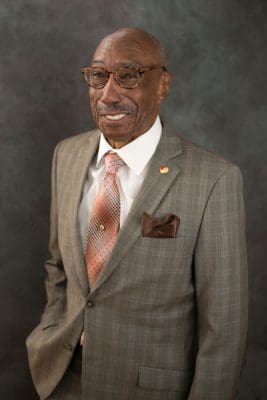
Click HERE to view Rev. Jimmie’s guided meditation during the service.
So, I want to start off with a little joke that I hope will lighten some of the heaviness of what I have to say.
So, there’s an old man, and he calls the fire department. And he says to the fire department, “There’s a woman on a ladder trying to get into my window.”
And the dispatcher said, “Sir, this is the fire department. You need to call the police.”
And the old man said, “No; you don’t understand. She needs a longer ladder.” [Congregants laugh] Okay. So, this is pretty bad. I didn’t say it was going to be a good one.
But I do want to, in all seriousness, share a little bit of what inspires the concept of Jacob’s Ladder in the Old Testament. In order to do that, we need a little bit of Jewish history.
So, this is one of my favorite pieces of Scripture. And I won’t go into that, because it’s long and pretty arduous to get to the depth of it. But it says:
“Now the Lord said to Abram, ‘Go down from your country and your kindred and your father’s house. To the land I will show you. And when you get there, I will make you a great nation. I will bless you and make your name great, so that you will be a blessing. And I will bless those who you bless, and also bless him who dishonors you. Because he I will also curse. And in you all the families in the earth shall be blessed.”
So, I thought about this scripture as I was trying to think of, “Okay, how am I going to deal with this particular topic?” And I thought about some of the Bible-spouting politicians who profess to be great Christians. And I wonder what they understand about the depth of this piece of Scripture and the dexterity of this piece of Scripture.
Blessings and curses are two-way streets. And when we get in the process of turning our government into a religious space, I think we’re heading down a dangerous pathway.
So tonight we get to explore this, I think, great piece of Scripture about Jacob’s letter. It’s from the book of Genesis: the 28th chapter, Verses 10-12. And, in a sense, it sort of describes a prophetic dream where a ladder – or, more appropriately, a stairway — connects Earth to heaven. And I love that picture that it presents in my consciousness. And it often reminds me of one of the O’Jays tunes about a stairway to heaven.
But the narrative in this story begins with Jacob fleeing from his twin brother Esau, who has vowed to kill him. And he vowed to kill him for stealing what he considered to be their father’s blessing. And in the dream, Jacob — who had stopped for a night’s rest at a place called Luz (L-U-Z). Jacob is sleeping, with a stone for a pillow. And he dreams of a stairway resting on the earth with its top reaching all the way up to where he sees the angels of God ascending and descending on it.
And as he beholds this powerful vision, Jacob recalls God’s promise to Abraham, who was his grandfather. That God had promised Jacob that the very land he is living on is for all of his descendants … Descendants as numerous as the dust of the earth. That’s a lot of descendants, believe me!
So, God also promises him divine protection and a safe return to the land of his birth. And as he awakens, sort of in a state of awe, he declares the place that he’s at as the house of God and the gateway to heaven.
Some deep metaphors here.
So. he sets up his stone pillow. as a pillar — a P-I-L-L-A-R — to serve as a marker. And then he anoints it with awe and renames the location Bethel. And then he makes a vow to serve God and to tithe a tenth of all he receives if God protects him on his journey.
So, most Bible scholars view the ladder as a symbol of God initiating a connection between the physical and the spiritual realm. And the Hebrew word for ladder is sullium — S-U-L-L-I-A-M — suggesting that the ladder is the step-by-step journey of ascension. Going up — we tend to think of ascension as going up.
But I want to bring it to another level and ask you to think about ascension as a concept for personal growth and for divine connection.
So, when we move away from the physical aspect of climbing a ladder to the spiritual aspect of climbing the ladder to a more practical process of ladder climbing — which is taking our spirituality in a step-by-step process … Never wanting to jump over any of the hurdles or the obstacles that appear before us because it appears to be easier.
And I suggest to you that that’s easier said than done. Because if we decide that we are spiritual beings, we want it to happen instantaneously. And we expect that, if it happens instantaneously, there won’t be any bumps or roadblocks along the way.
I’ve been on this journey for a long time, and bumps and roadblocks have become my best friends.
So, if we think about this from the aspect of climbing a ladder, just physically. Rule number one is: you should always face the ladder. In other words, you can’t get distracted if you’re going to be climbing a ladder.
I remember, as a youngster, wanting to climb up on the roof of the house and sneaking to my neighbor’s barn to borrow the ladder to do it. And then starting to climb up, and then taking my eye off of what was in front of me instantaneously. And then, boom! Laying on my rump on the ground. And the next thing I know, I’ve got my aunt, my mother, two or three other people in the neighborhood: [yells] “What’s wrong with you, Jimmie Scott?” [Congregants laugh]
Took all the wind out of my sails. But there’s a practical aspect to that. Because if you’re not paying attention to where you want to get to, then you can end up in trouble.
Your climb has to be centered between the side rails of the ladder until you reach the point of ascension that you set out to reach.
And I want to invite you to shift your attention away from Jacob and ladder climbing, and think about yourself and your process. And how are you going to realize the divine promise that those words I spoke about before are going to show up in your life? How are you going to be that whole, prosperous, strong, faithful person that you want to be? How are you going to be that integral part of a loving community that will help erase all of the negativity that takes place in our external world? That is our job as human beings: to be able to lift ourselves to that level.
In the Gospel of John, it states that God who created the world and everything in it is the Lord of heaven and earth. And that Lord — that Ruler; that Creator — does not live in temples, does not live in churches, does not live in synagogues, does not live in White Houses, etc. that are built by human beings. It is built in us. And each one of us has a degree of loyalty to that, because it’s our birthright.
So, this is interesting theology. Because when I hear the Secretary of Defense declare that we are in a holy war, I’m concerned. Because I’ve seen and lived through two periods of war. I’ve got friends and relatives who were scarred to the depth of their being fighting in a senseless war. And I’m concerned about it. And I think we all should be concerned about it.
At the same time, we all have to live. We all have to learn to get along together. And so, it’s a complicated process of being able to become open and receptive to people that you may disagree with with every core of your being and — at the same time — be supportive of one of the greatest nations in the world. And I think we are still that and we will always be that. So, it’s complicated.
Let’s share another piece of Scripture from the book of Acts: the 17th chapter; 24th, 25th verses. You’ll find this confirmation confirmed by the Apostle Paul. He states, “God made the world and all things therein. Seeing that he is Lord of heaven and earth, he doesn’t dwell in temples made with hands. Neither is he worshipped with hands as though he needed anything from hands. So, seeing and visualizing, he gives to all life, health and all good things.”
And when we read that in any one of the 15,000 or so versions of the wordings of that piece of Scripture, because there are so many different versions of the Bible that it’s hard to take seriously this idea that the Bible should not be interpreted, et cetera, et cetera, et cetera … because it’s been interpreted as much as 15,000 times. And it’s in sixth or seventh place in terms of longevity of so-called holy Scriptures.
So, we have to look at these things and understand these things from a level of personal inner integrity if we’re going to apply them to ourselves and to our neighbors. This life that we are living is not about religion, nor is this story about Jacob’s Ladder. What it’s really about is what’s possible: what’s possible for every one of us in this room. What’s possible for any of us that are here in whatever iteration we are here in. Because we show up differently in different spaces. And our spirituality is a part of that wholeness that we show up in.
We are here tonight because of what is possible in every one of our lives. It’s pretty much that simple. And we’re here because of what has been possible. And we’re also here because of all the choices that we’ve made to get here. And we are here despite the fears that we may have held at any point along the journey. We are here despite any impediments that we might have encountered along the way; any impediments that we felt like were in our way. And we are here because of the grace of the Universe showing up in the generosity of friends and family and strangers.
And I suggest to you that the ladder of opportunity is always within our reach and is always within you.
Every now and then, when my burden gets a little heavy in life, I pull out an old DVD of Charles Fillmore preaching about the simplicity and the complexity of life, and how to deal with both of those. And he can rattle off principle after principle, but he always goes back to one specific time or one specific thing. And that one specific thing is practice.
So, we can have all the principles and all the knowledge and all the understanding in the world. But if we do not practice the principle, then we don’t have hope.
His practice was pretty simple. If you read his works, two simple words show up over and over and over and over again: Turn within. Turn within.
And he said when your mind begins to argue against whatever you’re believing to be true about yourself, you have to turn within again. And he said if it’s not showing up the way you think it should show up, to turn within again, and affirm over and over and over again.
And one might think that that gets a little tiring. But legend has it that, when he was sitting on his porch in his 80-some years waiting for God to come and take him away, he was still affirming: “Turn within. Turn within.” That’s a powerful metaphorical perspective. But more important than that, it’s a major inner mental process. And it has outer physical rewards.
So, our challenge as humans is to reach for the top rung of the ladder.
Paulo Coelho — who was a novelist and lyricist who wrote the novel titled “The Alchemist” — said, “The world is changed by your example. Not by your opinions, but your example.”
So, reaching the top of the ladder emotionally, spiritually, psychologically, physically helps us to become better humans. And when we become better humans, we help create a better world.
Now, the downside of the process is: the more we age and think we are progressing, and the more our awareness is increased, we tend to become more jealous of our time and our energy and our efforts. So, we don’t want to spend that time turning within. We want to channel our energies in ways that feed us emotionally. But if we don’t feed the spiritual, the emotional becomes unusable for us.
So, history speaks to Jacob’s accumulations, because that’s what grabs our attention. We are told that the wealth he accumulated would surpass most of the billionaires that we have in the world today. And that’s attention-grabbing. But I want to suggest that peace of mind; expressing and receiving and giving; being enveloped in a caring community or a caring environment — those are the things that make the soul go, “Ah, this is good.”
So, climbing Jacob’s ladder is not about getting into the Pearly Gates some of the so-called traditional preachers like to rant about. It’s about an exploratory journey. And I would suggest to you that the greatest asset Jacob found was himself. And I’d like to also suggest that the greatest asset we find is ourselves: ourselves, just as we are.
If we go back in our mind’s eye to the experience of climbing the ladder … If you think about it, it takes some faith to step on that first rung with both feet, no matter what it’s perched against. And that’s the way life is. But we climb upwards because the ladder is perched against something that we trust. So, here we are.
Oscar Wilde said, “To live is the rarest thing in the world, because most people just exist.”
So let me wind this message down this evening with this little tidbit. It doesn’t matter whether climbing Jacob’s Ladder is literal or symbolical or metaphorical, et cetera, et cetera. It’s a tale about our faith. And in my mind, all faith is great. If you’ve got it, use it. You never know where it may lead you.
I’ll leave you with a little Charles Fillmore mysticism. No, in fact, it’s a lot of mysticism. He said, “Jacob represents the third arm of the Holy Spirit. And the ladder represents the step-by-step realization of our deep inner conviction of the assurance of the fulfillment of an ideal.”
Or, put another way, it means it is an inner conviction that prayer has been answered, although there may not be an outer expression yet.
So, in short, the final step of the ladder is conviction.
I did a sermon years ago on Jacob’s Ladder, and a wise and thinking congregant asked me afterwards why the ladder wasn’t available to anyone else. And the answer to me — then and today — is because the ladder was Jacob’s. If it was our ladder, we’d know it.
That’s Jacob’s Ladder. I’m done.