

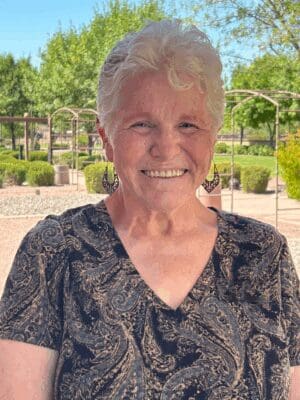
Click HERE to view Rev. Beci’s guided meditation during the service.
Hello again. Again, it’s Rev. Beci. I am Rev. Beci Rohkohl. I’m the Youth and Family Minister here at Unity of Phoenix Spiritual Center. And every once in awhile they give me the mic. So, one of these nights … aren’t you lucky you’re here on one of those nights, right? Maybe. We’ll see afterwards. You can let me know.
We’re kind of in the middle of a book right now. I’m actually … I get To do chapter, guess what? Six, seven! Uh-huh. I said it. [Laughs] So, it’s called “The Practice of Groundedness.” And Chapter #6 is about being in deep community, and Chapter #7 is about movement. These are spiritual practices that we use.
So, essentially, when we start with being in deep community — what the author Stulberg is trying to say is that — we are not meant to be alone. We’re meant to be in deep community. And there’s a difference between knowing someone and knowing someone. You guys know that, right? Because I know a lot of people, but do I really know a lot of people? You know, how deep do I connect?
When I started my spiritual healing journey many, many years ago — we don’t want to count that one; decades, right? I used to talk with people and I’d hear them, and I could get a vibe for what was going on. And oftentimes I would talk to people that I called “surface dwellers.” It’s like they live here. [Pantomimes the surface] They live in here, and this is comfortable, and they’re good. And they can talk to talk, and they can stand in there and say what they needed to.
But nobody would be willing to go deep with me, and I really needed somebody that could go deep. Somebody that could feel me, somebody that could hear me; somebody that could understand me; somebody that could connect with me on that deep level. And I found a lot of people that were here [surface-level], but not too many that were here [deep].
And I’ve found over all these decades of learning that I’ve kind of realized that: that’s where a lot of people kind of hang out — is on the surface. And what the author is asking for you, with deep community, is to say find those people. It doesn’t have to be a lot of people. Maybe it’s one, two; maybe it’s three. But someone that you can have that deep community with; connect on a different level.
And then Chapter #7 — we’ll go into — is talking about moving our bodies. And there’s a lot of new data around how movement and mental health keep you focused, keep you going, keep you grounded. So, they’re relating a lot of that, too. And when I first started this journey of healing and growing, there wasn’t that much data on that, either. So, I’ve learned as the system has learned and backed it up, that this is all; it comes together in these ways.
So, we’ve walked through five chapters already on the book. If you didn’t get to see them with the other ministers, they’re on YouTube. Go take a look. Rev. Stacy and Rev. Jimmie. And I think Rev. Stacy and Jimmie are the ones that have delivered. I don’t think Rev. Maraj has.
But for Chapter #6, we’re talking about BUILDING THAT DEEP COMMUNITY. We need people to truly know who we are. They need to be able to see our warts and all, right? We need people like that. I was speaking earlier to one of the ladies in the audience, and I said, “You know, I have this very close friend, and I’ve known her for decades. And she often tells me, ‘Are we talking about Beci? Because the world does not revolve around Beci.’” You know, it’s like … because she knows that part of me. That when I go into myself and go, “Oh, it’s all about me,” she’s like, “No; pull out of that because I know better. It’s not all about you.”
So, we live in a world that tells us to anchor our worth in productivity and appearances and constantly achieving. It’s that drive. Look at our phones. I mean, it’s constant, constant connection; it’s constant achieving. For those of you that don’t know me, I’m a custodial grandparent for four of my grandchildren: all girls, all teenagers. And we talk a lot about the cell phones, because it’s important for them to know that that one snapshot they got of their friends or whoever — whoever, whatever influencer they’re following — was a moment in time that might have taken 40 times to get there; It might have taken four years to get there, right? But they’re scrolling through and thinking, “Oh, it’s perfect!”
But it was just that one moment in time that happened. That doesn’t mean that’s who they are or who they really are or what is really going on in their lives. Because you just never know what’s going on beyond that, right?
So, we have to be very careful. We want to judge, like I said, on productivity. How much can you get done? Even the job market has gone to productivity. My husband is a — he’s kind of upper level management for a Fortune 500 company. And the way they’re doing jobs now is they’re doing these little term-limit jobs. We’ll hire this person for a two-year term, and if they get this much done, then they get paid and they move on. It’s like: How much can you get done for somebody? How much can you prove your worth?
And this is what we’re measuring people by. And that’s … we’ve lost something here in doing that. Because we’ve become so entrapped in getting it done, looking right, going on to the next achievement.
And if you think about a spiritual community like a grove of trees, okay? So, for instance, if you’ve got a grove of trees and they all grow from each other, what happens when a really big wind comes through, the trees that are all closer together can usually withstand the wind. It’s the ones that are out here on the outside that had just sprung up or whatever … They’re usually the ones that get the worst of it.
And I can give you an even better example. Because we’re horse people at our house. The horse that gets kicked out of the gang is the one that’s not going to make it. Because the alpha horses will throw horses out for their behavior or whatever it is. But if they’re out there by themselves, flying solo, they’re not going to make it. They have to be part of something else. That deep community — that belonging to something else.
That’s one of the things that we try really hard to do here at Unity of Phoenix Spiritual Center: is create a sense of belonging. Because we all belong here. This is all a part of who we are. We’re all a part of each other. It’s our first principle, right? We’re all one. So, if we’re all one, who could be on the outside? We can’t place anybody on the outside, because we’re all one.
So, we want to share our strengths. We want to share that community. And a spiritual community like this is very important. So, one of the things that you want to do is to be able to have a spiritual community. You want to be able to show up as who you are. Anybody ever been to a place and show up and you’re like, “Ooh; they don’t want me to be me here.” Am I the only one? No? Okay, good. I’m not! I’m thinking, “I’m the only one in this room.” I have been to places that I’ve showed up, and I’m like, “Yeah, they want a different face on when I walk through this door. Because if I came in as me, they’d be like, ooh, ‘Who’s the stranger in the room?’”
Heck, it’s like that in my own family. I’m not talking about my immediate family with the kids. I’m talking about my birth family. You know, I am the black sheep. That explains a lot about me right there, right? Being the black sheep of your family. Because they don’t want me to show up as me. That’s why I don’t get invited to things. Because I bring the truth. I bring the truth principles. I bring things that are outside.
So, I want to be in places that I can show up as I am. Like here. I can show up as who I am. I can be myself. And maybe I’m not everybody’s cup of tea. Maybe you’re not, either. But there are people here that love me deeply, and I know it. And not just family members by blood. I know that I’m loved. And I appreciate that just for being me. Weird as I am sometimes, I can still be me.
So, we want to be in a place where we can give and receive support. Anybody ever had people in life that just keep taking the support, taking the support, taking the support, instead of giving it back? It can get exhausting and you run out sooner or later. Because they keep wanting to take and you run out of things to give. Because your tank runs drive, because you’re just trying to give.
That is, well, in reality, the cycle of co-dependency, right? I’ve been in those 12-step rooms plenty of at times. You know, “Hi, my name’s Beci, and I’m the adult child of alcoholics.” It’s the same thing. Or I’m a co-dependent, you know. Because I give and I give and I give and I give and I don’t get anything back.
I want to be in a place where, what I give out, I give back. Maybe it’s not in the same measure on the same day. You can’t expect that. But have it be reciprocal, definitely.
And a place where you can pray with each other, not for each other. I want you to hear that, right? I can pray for you or I can pray with you. Do you feel the difference in the energy? I am going to pray for you. Somebody says, “I’m going to pray for you,” or somebody says, “Let me pray with you.” This is what our chaplains do, right, Cay? Let me pray with you. Because it’s being with you in that community, in that deep community, that makes that belonging and keeps us connected.
So, Stulberg reminds us that isolation erodes our groundedness. Haven’t we learned this with COVID? I mean, this has been the past how many years? It feels like 10, 20. Isolation has been really knocking on everybody’s door, and it takes away our centered self. It takes away our groundedness. It takes away and eats away from who we are.
Again, you can’t plant one plant way out here by itself or one horse way out here or one tree way out here, and then have the rest to go over here, and hope that that one’s going to make it. Being part of that community — we want to be in that and connected to it.
So deep community provides truth-telling, even when it’s not fun. Anybody ever tell you the truth? And you went, “Oh, man, that yard. But I took it.” I get it all the time. I have some really powerful friends that just say it. They’re not mad or they’re not judgy when they do. They’re just like, “Hey, Beci, are you listening?” And I’m like, “Yeah, something else to work on. Thank you. I’ll put it on my list of things to take care of while I’m doing it.” Right?
Deep community provides emotional regulation. They call you on your emotions. “Hey!” And it’s not just that; they support you in those emotions, as well. That’s what the community is for. They help you through what you’re going through; support you in it in many, many different ways. And they give you perspectives during stress and success.
So, my very best friend tells me when I get really excited about something that really happened. For instance, I got this job, and I was so excited. Because I used to attend here many years ago. And I just recently came back. I’ve only been back here six months. Just over six months. Yay, me! [Laughs] But I was excited. I go, “Well, it has been six months!”
But I was so excited when I was offered the job. And I called her. I said, “Yay!” And she said, “Put some of that in your pocket.” And I said, “Oh, you have to tell me this every time.” Because some of that joy needs to get put away. Because when you get there and you start living in the reality, there’s going to be times when there’s not that much joy. And, believe it or not, even being a minister there are times when there’s not; that there’s some things that come up and you go, “Oh, that wasn’t fun you know.” And then I pull that out of my pocket and I go, “Hey it’s a joy to be here; I’m in my community! I’m back where I belong” …
So, one of the things that I’ve learned along the way is that some people are worth being in community with and some people are better to not be in the community with me. They have their community, and sometimes I have to step out of their community, because it’s not a community that supports who I am.
And that’s okay, because they’re where they are. And at one point, guess what? I was there, too. At one point, I couldn’t support the me that is here now. Sounds weird, doesn’t it? But it’s true. Because if you had looked at me 10, 15, 20 years ago in community, I would have shown up differently than I do now. So my community has changed along with, so have I changed.
So, from Unity’s perspective, you look at it like this: one Presence, one Power, many expressions. We’re in community, but we all express differently. And that’s what we are. That’s who we are. And that’s the best of who we are.
That Spirit is revealed through relationships. I can sit home all day long and think I’m getting everything right. But if I don’t put it in play with somebody else, how do I know? How do I know that it’s going to work? How do I know that it’s going to be real? How do I know when I don’t step into that moment that I go, “Oh, maybe this should be different? Maybe this feels different here”? Because I have to put it in
relationship with someone else.
And belonging stabilizes our consciousness. When you are part of something else, you feel more stable. You feel good and you feel able to be yourself when you’re in the right community; when you’re in that deep community. And, like I said, we can’t expect that a room full of 400 people is going to be — all of them — are going to be our community. But we can find a handful of people inside that room that are in our community.
And through the Unity lens, they say that interdependence reflects spiritual maturity. So, doing this shows that you’re spiritually mature … or maturing in your spirituality. Because I don’t know about you guys, but I’m a work in progress. I can say this now. In 10 years from now, I may be saying, “Oh, you know, I learned better. Here I am. This is what I’m doing. Because I know that I, every day, I’m going to show up, and I’m going to keep working on myself, and I’m going to keep growing.”
But we’re not meant to awaken up to the spirituality alone. One of the things I learned in 12 Steps a long time ago is: you have to do the work for yourself. You just don’t have to do it by yourself. Those are two different things. I can’t make somebody do their work or change their lives. But I can stand by and help them when they decide to do it. I can be a part of their growth. And I can share my experience, strength and hope with them.
And I can show that, you know what? If I can do it … I’m telling you, there are so many people out there that don’t have the confidence in themselves, and I want to just go and hug them and say, “You have no idea how many things I’ve been through in my life to get me where I’m at.” I mean, 90% of what I’ve been through, my grandkids don’t even know the stuff that I’ve been through in my life.
But to get me where I’m here, but everything I went through in my life got me here. And this present moment is just amazing to be living in. There’s a world of amazement here, and this community is just amazing to me.
So, growth happens in a safe, honest relationships. And, as one of my friends says — from Matthew 7: 6 –she says, “Don’t give what is holy to the dogs, nor cast your pearls before swine. They trample them under your feet and turn and tear you into pieces.” She said, “Don’t throw your pearls before swine.”
In other words, don’t just tell anybody your story. It’s that deep community you’re looking for and be able to connect to.
So, we’re not meant to do it. We are not meant to do hard things alone. Remember that. This is what the author is telling us: Groundedness comes from a few deep relationships, not a lot of shallow ones; no surface dwelling. We need people who can tell us the truth and help us stay aligned with our own values.
And extreme self-reliance is often a recipe for burnout, not strength. And that’s true. I know that from myself. And just recently, over the Christmas vacation, the kids were up at their sister’s house. So, I was in the house by myself, which rarely happens. Me and the dog and the cat, I got really super sick, and I just stayed in bed thinking, “Oh, yeah; I’ll get over it. I’ll get better, it’ll get better. I can do this.”
And I just got sicker and sicker and sicker. I kept calling into work saying, “I can’t make it today. I’m just getting sicker.” Finally, about the seventh day, I was like: you know what? I might need some help here. So, as they were coming back from their sister’s house, I went to the emergency room and found out that I had a really bad case of COVID. And had to spend the night because of other things.
But I realized, okay, Here I was again, even where I’m at now, thinking, “Oh, no, I got this all by myself.” I didn’t call friends for help. I didn’t ask for prayer. I didn’t … You know, I was just like, “Oh, I’ll just lay here and I’ll get better. It’ll be fine. I’ll drink a lot of water and eat some soup, and I’ll be okay.” But it didn’t happen like that. I had to reach out.
So, we’re not meant to do them alone, and extreme self-reliance is often a recipe for burnout. So that’s Chapter #6.
And we’ll move into Chapter #7. And I think it’s no coincidence that I got these two chapters: the reminder about community and the reminder about movement. Because just recently I hurt myself really bad, too. And I’m just like, “No, you have to keep moving.”
Moving our body grounds us. Movement. And I’m not saying run out and run a marathon or do the triathlon or do the Iron Man. That’s not what they’re talking about in this book. They’re talking about just keeping yourself moving.
So, I learned a lot about this years ago when I was quickly immersed in a family emergency that brought me into the mental health fields. I wasn’t actually learning how to be in mental health fields. I actually was working with NAMI. I needed help and assistance. And the closest assistance I had from a mental health facility was more than two hours away. And I needed someone to help me with family members that were struggling really bad. It was quite devastating.
And so, I decided, you know: I’m going to see what I can do about getting this organization closer. So I found a couple of people; a couple of friends – quickly became friends. And through the National Alliance of Mental Illness, I took so many classes and everything. And I realized that movement is a big part of mental health.
And if you don’t believe it for sure, think about this: oftentimes — especially when the teenagers … and I’m not pointing fingers at them, because I know adults do this, too — do this on their phones. [Feigns hunching over a phone] They’re down in their feelings, their head’s down; their whole body’s hunched over. You see that, right? The hunched over, all that. This is here.
That’s being down in our emotions. Because when you do this, bring your shoulders back and your chin up, you physically and emotionally can’t stay in that emotion anymore. Try it. It actually works! And there’s science that backs it. That once we start shifting how we are — shifting our emotion, shifting even just our body, moving — the chemistry changes all throughout us.
So, movement has a multitude of benefits and is helping us stay grounded. It’s just one of them. And, in fact, in 2024 there was a review of the Psychiatric Mental Health Journal Report that says exercise reduces symptoms of anxiety, depression; improves the mood; supports cognitive function; better body flow; it increases brain-deprived neurotropic factor – which is B-D-N-F. That’s scientific enough for you. It reduces inflammation and exudative stress. And that’s just one of the thousands of reports that are out there that we’ve got to get moving.
I didn’t know this years ago. It would have been nice to know when I was a teenager; when I was down in that, you know. My thing was … I wasn’t like this on the phone. I’m not going to pretend like I was. I was in my bed with my record player going, and my CB radio. Did anybody have a CB besides me? Ahhhh … Nobody’s raising their hand. Okay; good. Finally! I was like, “Wait; no! Was I the only one? Breaker, breaker.” [Laughs] Calling my best friend from the long distance on the CB radio. Because we didn’t have cell phones in our bedrooms. I didn’t have a phone in my bedroom. And the only phone we had, we had a long cord, and we had to walk around the corner at the house.
But anyway, I digress. So I had that same thing. I was all curled up in a thing, and I knew — but nobody had the experience or the understanding that, if I got up and I moved, I could actually change the chemistry in my body. And then it would help me be, not only grounded and present, but feel more alive; feel more connected to what’s going on in my life.
So, in his book, he talks about that stress lives in the body. And a few years ago, I read a book called, what was the name of it? “The Body Keeps Score.” Has anybody read that? It’s a good book. It talks about all the trauma that can happen in a life and how it’s stored inside your cells inside your body until it’s released.
And one of the things I learned many years ago, too, is that … Have you ever noticed how animals react to stress? So, a rabbit’s getting chased along, chased along, chased along, whatever … Gets away from whatever is chasing it, and then it does this shake: really violent shake. It’s actually releasing the energy of just what it went through.
But we, as humans, no! We hold on to it. We talk about it. We drag it through years of therapy, you know! We keep it stored: “Oh, gosh, they did that to me. I’m holding on to that.”
I know somebody in my life that’s in their 80s that is still telling the same story that happened when they were in their 20s. And it’s the exact same words all the time. And it’s so traumatic. And you’re like, “Are you going to let this go?” I can’t imagine what it’s done to her body over all the last 60-something years. You know? But there it is. Because it’s so important for them to not let go of it and to not move on from it. They have that stored inside there and they won’t let it go.
So, they talk about that regular movement improves your focus, your mind, and your resilience. It helps your nervous system as well as your mood.
So, what kind of movement? Do I have to do jumping jacks? Do I have to run triathlons? Do I have to do Iron Man? No. He talks — the author talks — about walking, stretching, gardening, cleaning. General exercise; just movement.
Is there anybody in here that has a job that sits all day? Yeah, these sedentary jobs. We’ve got this. Anymore now, most jobs are where you sit on your rear and work. My husband has a standing desk now, because he doesn’t want to have to sit. But he’s still standing in the same spot! You know, IT; you’re still standing in the same spot.
But moving away from that … he says even if you take, like: for instance, I set a timer on my phone; every hour it gives me a little ding. On that little ding, Iwalk out, I walk around the building, I walk back, and I start again. That’s movement. Any kind of movement helps. As long as we keep moving.
So, make it a part of your job to over-exaggerate your movement. Say you have to go to the printer. Go to the printer! Show a little joy — a little pep in your step — when you go to the printer! Stop and say hi to somebody around the way. “Hey; how’s it going? Haven’t seen you today.” You know? Do anything that over-exaggerates what you just normally do. Walk into the kitchen; you’re cooking dinner. I love this! Turn on the music and cook dinner. Man, you get the right music going, you can be dancing around the kitchen island, doing all kinds of fun stuff. And even the food tastes better, I think. [Laughs] Food cooked with joy always tastes better, right?
So, any little thing can help. So, any type of exercise, regular routines, especially stretching; even yoga. Chair yoga. Do you know that I’ve seen … Even if people are like, “Oh, I can’t do that, you know, can’t do this.” I saw this program … and, of course, I doom scroll. I saw this program where this girl lost 100 pounds by sitting and dancing. Just like, you know, chair yoga: sitting and dancing. She’s got the music — I mean, the ragtime music going — and she just, bom-bom-bom-bom-bom. And you can see her body, over the time, shrinking down. And you’re like … It’s because she couldn’t at the time — she was so heavy that moving around would have hurt her joints. So, she started in a chair before she could get up out of the chair. Can you imagine just how good that felt? The chemicals running around inside her brain and how good that felt?
So, schedule these workouts; prioritize them. Even if it’s five or 10 minutes; even if it is that walk. Even if it is when that bell goes off to take three breaths, stand up and stretch. Stretch your body. And take three long breaths. Something different; put some kind of movement in and it will help balance that out.
So, the body is a sacred vessel, the author says, of awareness. And movement returns us to right now. Because when you’re in movement — when you’re running — you can’t be thinking about yesterday. When you’re exercising … And when you do … I should say you can be thinking about yesterday. But when you do, guess what happens? A lot of times you hurt yourself. I know I do. If I’m too busy thinking about something else while I’m trying to move around. I ran into walls.
I wasn’t here two weeks and I broke two toes. Tell me what that was about. I was, like, so busy thinking about my job and getting my house set up and getting these kids registered for school. I was so far out in my head that I wasn’t even paying attention to where I was setting the furniture in the house; ran into walls. Two weeks separate from each other, broke two separate toes. While it wasn’t in my body, I wasn’t grounded for sure. And this is recently! So …
And stillness and motion work together. Being connected and motion. This is how Tai Chi works. Does anybody do Tai Chi? Yeah, one of the best ones, right? Tai Chi is because you had that stillness and the movement at the same time and practice.
So, his wisdom – Stulberg’s wisdom — says small, consistent practices matters more than intensity. Being even but small and consistent — it does more for your body than the intense every once in a while.
One of the things that I recall — and I use this often; I don’t know if anybody in here has heard it yet –there’s an African proverb that says, “Pray and move your feet.” That’s our fifth principle. You know, we’ve gone through all the principles to get where we’re at, but the last one says what? It’s not enough to know it. It’s just like the 12th Step: it’s not enough to know this practice; we have to put it into practice. We have to actually move our feet and do the work that needs to be done.
So, move your body to ground your mind. This is what he says are the five points:
You can’t think your way out of stress. Haven’t we ever tried? I have! “Oh, I’ll just let go out of stress. I’ll just keep thinking about it more.” It doesn’t work.
The body’s the fastest way back to the present moment. And I know this for a fact, because when I first started ministering and standing in front of all of you guys, it’s like I asked one of the other ministers, “What happens when I get to a point where if I start to cry or something? How do I bring myself back into my space?” She said, “Bite your cheek.” You bite your cheek, you come back to the moment real fast! Even in the middle of a tear or whatever, you come back to the moment. So it is one of the ones that will bring you back real fast.
Regular movement matters more than intense movement.
And grounding movement does not need to be extreme to be effective.
So he reminds us that something that is also Unity wisdom is that wisdom is not just mental, it’s embodied. We have to embody it.
So, in summary for the chapters, this is what he’s saying: movement has historically been a cornerstone for health and humanity. While not a cure-all, it is a vital role in physical and mental well-being, helping individuals embody and engage life more fully.
To be grounded is to move, reinforcing the principles of acceptance, patience and community. The pursuit of happiness can often feel like a daunting journey, but integrating movement into our daily lives can significantly enhance our emotional well-being. By embracing physical activity to achieve mental clarity and focus, we can cultivate a deeper sense of joy.
Additionally, stabilizing a routine that includes movement supports the idea that happiness is a result of both physical and mental health, ultimately encouraging overall life experience.
So, as we wrap this up, it says this: “Deep community and regular movement keep us grounded, because they stabilize our hearts — our spiritual connection as well as our physical nervous system. Remember: when you’re grounded, you’re supported. And you’re not alone. Practice one breath, one step, one loving connection at a time. We don’t have to have it all right now, okay?
And we’ll come back to the affirmation that we had — if we could say it all together: “As i nurture community and move with intention, I awaken groundedness, joy and resilience.
Namaste.